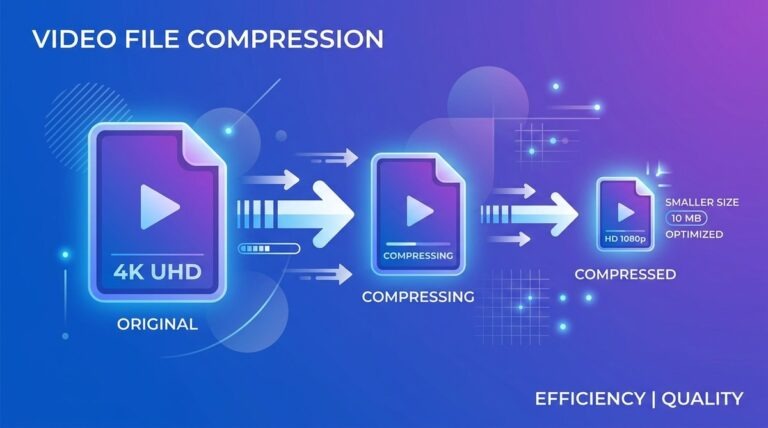
Are your videos too large, slow to load, or losing quality when uploaded to platforms like TikTok or YouTube? Video compression technologies are the key to optimizing file size while maintaining the visual quality viewers expect. In this article, you’ll explore the top 7 video compression technologies in 2026 such as H.264, H.265, and AV1, and how they help reduce file size, improve loading speed, and enhance viewing experience. You’ll also understand how to choose the right codec and optimize videos effectively for different platforms.
What Is Video Compression Technology an Basic Working Principle
Video compression technology is the process of reducing video file size while still maintaining the best possible visual quality. It makes videos easier to store, faster to load, and more efficient for online streaming.
Instead of saving all data in every single frame, compression systems analyze the video and remove unnecessary or repetitive information. As a result, file size is significantly reduced while the difference in visual quality is often barely noticeable to the human eye.
In general, video compression works based on two main mechanisms:
-
Reducing data within a single frame: Areas with similar colors and details are grouped together to optimize storage efficiency.
-
Exploiting similarity between frames: Instead of saving a completely new image for every frame, the system only records the changes between consecutive frames.
In addition, most modern videos use lossy compression. This means some data is removed during processing, but it is optimized in a way that keeps the viewing quality nearly unchanged in real-world usage.
Thanks to this mechanism, videos can be delivered more smoothly over the internet, reducing lag and improving user experience on platforms such as YouTube, TikTok, and streaming websites.
Video compression technology is the process of reducing video file size
7 Best Video Compression Technologies Available Today
Video compression technologies play a key role in reducing file size while maintaining high visual quality, making videos faster to load and easier to stream across platforms.
1.H.264 (AVC)
H.264 (Advanced Video Coding – AVC) is one of the most widely used video compression standards in the world today, applied across streaming platforms, social media, and many digital systems.
This technology is preferred because it balances video quality and file size, allowing videos to remain sharp while being easier to store and transmit.
Key Features
-
High compatibility: Supported by almost all devices and platforms (smartphones, PCs, browsers, TVs).
-
Optimized file size: Significantly reduces video size compared to older standards while maintaining stable quality.
-
Stable performance: Suitable for online videos, live streaming, and social media content.
-
Easy deployment: Does not require powerful hardware for encoding or playback.
Common Applications
-
YouTube, TikTok, Facebook videos
-
Social media video sharing using tools like SnapTik
-
Live streaming and video calls
-
CCTV surveillance systems
-
Web videos and online content
Limitations
-
Less efficient compression compared to newer codecs like H.265 or AV1
-
Not optimized for high-resolution 4K/8K videos
-
Gradually being replaced in modern systems
H.264 remains the most reliable and widely used video codec today thanks to its stability and broad compatibility, even though it is no longer the most efficient option in terms of compression performance.
2. H.265 (HEVC)
H.265 (High Efficiency Video Coding – HEVC) is the successor to H.264 and is designed to deliver significantly better compression efficiency while maintaining similar or higher visual quality.
This codec is widely used in modern streaming services and high-resolution video formats, especially 4K and 8K content, thanks to its ability to reduce file size without sacrificing detail.
Key Features
-
Higher compression efficiency: Reduces file size by around 50% compared to H.264 at the same quality level.
-
Better support for high resolution: Optimized for 4K and 8K video streaming.
-
Improved visual quality: Maintains sharper details even at lower bitrates.
-
Efficient bandwidth usage: Ideal for online streaming and data-heavy content delivery.
Common Applications
-
4K/8K streaming platforms
-
Ultra HD Blu-ray discs
-
Video-on-demand services (Netflix, YouTube, etc.)
-
Modern video recording devices and cameras
Limitations
-
Higher processing requirements compared to H.264
-
Encoding is more complex and slower
-
Some licensing and patent restrictions
-
Not fully supported on older devices
3. AV1 (AOMedia Video 1)
AV1 (AOMedia Video 1) is a next-generation open-source video compression codec developed by the Alliance for Open Media, aiming to replace older standards like H.265 with better efficiency and zero licensing costs.
It is designed for modern streaming platforms, offering superior compression performance while maintaining high visual quality, especially in web-based video delivery.
Key Features
-
Superior compression efficiency: Reduces file size by about 20–30% compared to H.265 at similar quality.
-
Open and royalty-free: No licensing fees, making it attractive for major tech companies.
-
Optimized for streaming: Designed specifically for internet video delivery.
-
High visual quality: Maintains detail even at low bitrates.
Common Applications
-
YouTube streaming
-
Netflix and other OTT platforms
-
Web video delivery (HTML5 streaming)
-
Future-ready video distribution systems
Limitations
-
Very high processing requirements for encoding
-
Slower encoding speed compared to H.264 and H.265
-
Hardware support is still expanding
-
Not yet fully adopted across all devices
4. VP9
VP9 is a video compression codec developed by Google as an open and royalty-free alternative to H.264 and a competitor to H.265. It is widely used for web video streaming, especially on platforms that require efficient delivery at high resolutions.
This codec is designed to reduce bandwidth usage while maintaining good visual quality, making it a strong choice for online video playback.
Key Features
-
Efficient compression: Provides better file size reduction than H.264 while maintaining good quality.
-
Free and open-source: No licensing fees required.
-
Strong web optimization: Works especially well for browser-based video playback.
-
High-resolution support: Handles HD and 4K streaming efficiently.
Common Applications
-
YouTube video streaming
-
WebM video format
-
HTML5 video playback on browsers
-
Android-based video applications
Limitations
-
Slower encoding compared to H.264
-
Less efficient than newer codecs like AV1
-
Hardware support is not as widespread as H.264
-
Mainly optimized for web environments, not professional editing workflows
5. H.266 (VVC)
H.266, also known as VVC (Versatile Video Coding), is the successor to H.265 and represents the next generation of video compression technology. It is designed to significantly reduce file size while maintaining or even improving video quality, especially for ultra-high-resolution content.
This codec targets future video standards such as 8K streaming, virtual reality (VR), and advanced multimedia applications where efficiency is critical.
Key Features
-
Extremely high compression efficiency: Reduces file size by up to 50% compared to H.265.
-
Optimized for 8K and beyond: Designed for ultra-high-definition and future display technologies.
-
Improved visual preservation: Maintains detail even at very low bitrates.
-
Advanced encoding algorithms: Uses more complex processing to achieve better compression results.
Common Applications
-
8K video streaming
-
Virtual reality (VR) and augmented reality (AR) content
-
Future broadcasting systems
-
High-end video production and research applications
Limitations
-
Very high computational complexity
-
Slow encoding and decoding process
-
Limited hardware and software support at the moment
-
Still in early adoption phase
6. MPEG-4
MPEG-4 is a digital multimedia standard developed to handle video, audio, and other types of media in a highly efficient way. It is one of the foundational technologies behind many modern video formats, especially MP4 files.
While MPEG-4 is often associated with video compression, it actually refers to a group of standards, with MPEG-4 Part 10 being widely known as H.264.
Key Features
-
Wide compatibility: Supported by most devices, players, and platforms.
-
Flexible format: Can store video, audio, and subtitles in one container.
-
Efficient compression: Provides good balance between quality and file size.
-
Standard foundation: Forms the basis for many modern video codecs.
Common Applications
-
MP4 video files
-
Online video streaming
-
Mobile video playback
-
Digital media distribution
Limitations
-
Not a single codec (can be confusing in classification)
-
Older parts are less efficient compared to modern codecs
-
Limited optimization for ultra-high-resolution video
-
Gradually replaced by newer standards like H.265 and AV1
7. ProRes & DNxHD
ProRes (developed by Apple) and DNxHD (developed by Avid) are professional intermediate video codecs widely used in video production and post-production workflows. Unlike delivery codecs such as H.264 or H.265, these formats prioritize editing performance and image quality over file size reduction.
They are commonly used in filmmaking, broadcasting, and professional editing environments where maintaining maximum visual fidelity is more important than storage efficiency.
Key Features
-
High visual quality: Preserves maximum image detail with minimal compression loss.
-
Editing-friendly: Enables smooth playback and fast editing in professional software.
-
Low compression artifacts: Maintains clean image quality during post-production.
-
Optimized for workflows: Designed for rendering, color grading, and compositing.
Common Applications
-
Film and TV post-production
-
Professional video editing (Premiere Pro, Final Cut Pro, Avid)
-
Color grading workflows
-
Broadcasting and studio production
Limitations
-
Very large file sizes compared to delivery codecs
-
Not suitable for streaming or online distribution
-
Requires significant storage capacity
-
Not optimized for mobile or web playback
Comparison of Popular Video Compression Technologies
The table below highlights the key differences between popular video compression technologies in terms of performance, quality, and usage.
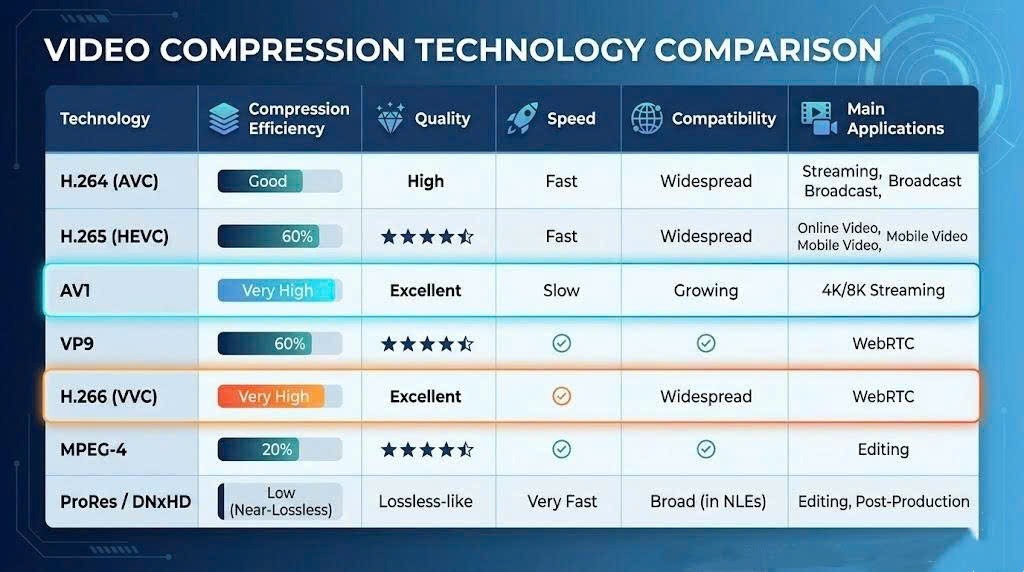
Overview of video compression technologies
Each video compression technology has its own strengths and is optimized for different use cases.
-
H.264 is the most widely used thanks to its high compatibility and fast processing speed.
-
H.265 significantly reduces file size while maintaining good quality, suitable for 4K/8K videos.
-
AV1 offers very high compression efficiency and strong quality, but is slower to process.
-
VP9 provides a good balance between quality and performance, commonly used on the web.
-
H.266 is the most advanced generation but is not yet widely adopted.
-
MPEG-4 is stable and widely used for standard-definition videos.
-
ProRes/DNxHD focuses on high-quality output for professional post-production.
In short, there is no single best compression standard. The choice depends on the purpose: streaming, storage, or video editing.
Conclusion
Video compression technologies play an important role in optimizing file size, improving loading speed, and enhancing the overall viewing experience across all platforms. Codecs such as H.264, H.265, AV1, and VP9 each have their own strengths, serving different purposes like streaming, storage, and professional video production. There is no single best video compression standard. The right choice depends on real-world needs whether you prioritize speed, visual quality, or device compatibility. Understanding each technology helps you optimize video performance more effectively in 2026 and beyond. If you are producing video content, focus on choosing the right compression technology to optimize performance, reduce file size, and deliver a smoother viewing experience for users.